Give your office its year back.
A congregation of 300 households loses about 546 hours a year to work nobody chose: the same family typed into five systems, the newsletter written from a blank page, the statement run done by hand. That is 1,638 conversations with members that nobody has time for. Kehilo is one system for all of it, $299 a month.
You are not short-staffed.
You are short 546 hours, which is 14 working weeks a year, and they are going into the gap between the systems you already pay for rather than to the people you employ somebody to look after.
“We do not have enough staff.”
Probably true, and another hire is the expensive way to fix it. One person on your team is already spending the better part of a day a week as the join between five systems, re-typing what one of them already knows into the next. That is not a staffing problem. It is a plumbing problem, and it is cheaper to fix the plumbing.
“It has always been done this way.”
It has, and it worked when the congregation was smaller and the tools were a filing cabinet. What changed is that each new thing (the website, the newsletter, the school portal, the card reader) came with its own copy of your membership, and nobody was ever given the job of keeping five copies in step. So everybody does a little of it, all the time, and nobody calls it work.
“The volunteers handle it.”
Volunteers handle the parts that are visible: the event, the appeal, the kiddush. Nobody volunteers to reconcile a spreadsheet against a card statement, so that part lands on the one member of staff who cannot say no, usually after six.
What it is costing you
546hours a year back, about 14 working weeks
Which is 1,638 twenty-minute conversations with members that nobody currently has time for.
Sixty per cent of the administration hours go, because the five records become one. Seventy five per cent of the writing goes, because it drafts and a person approves. The rest needs a person and stays with your person, and nothing reaches a member without them.
Put the rest of your numbers in and it will tell you plainly if you are better off staying where you are.
Computed, not drawn.
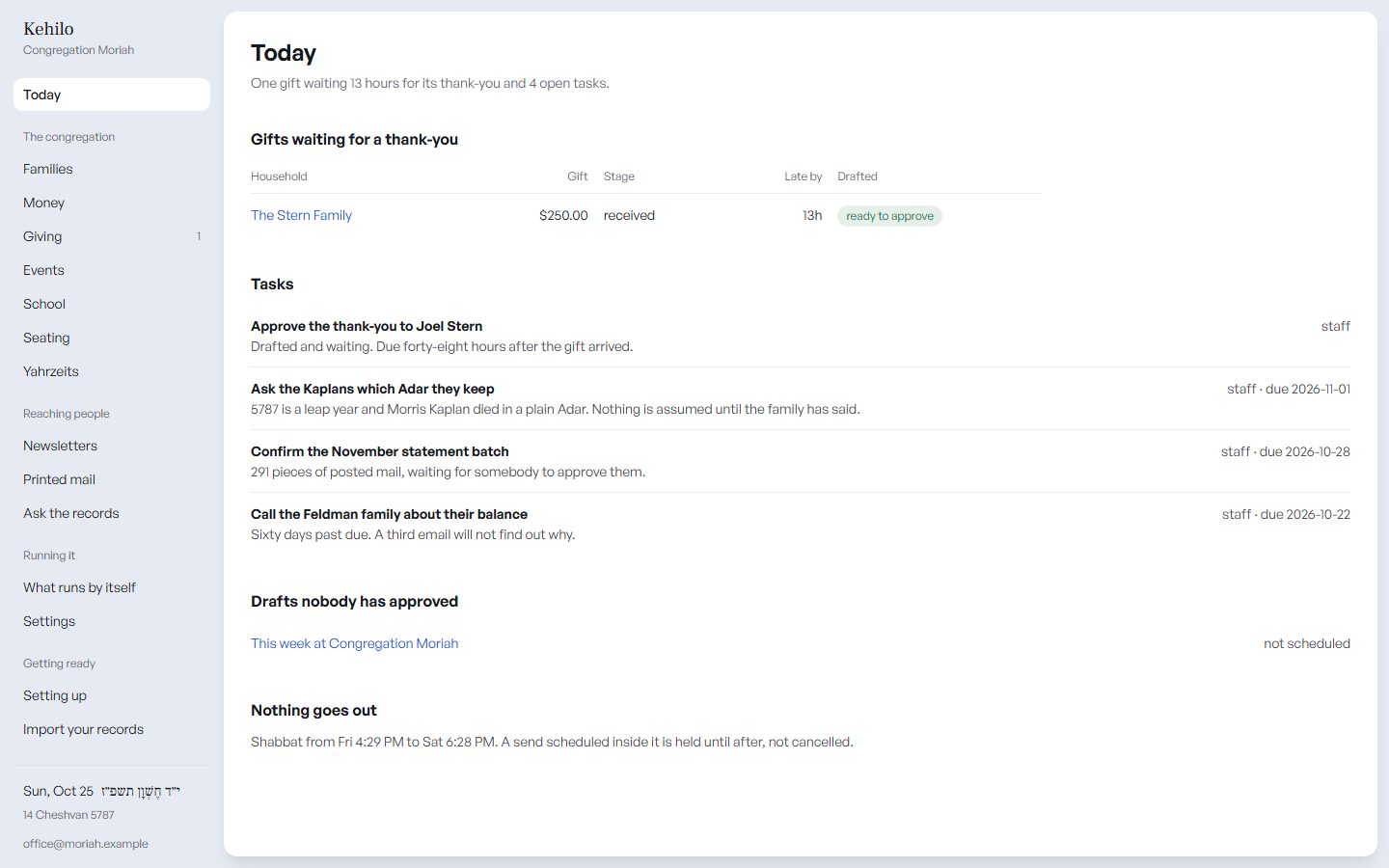
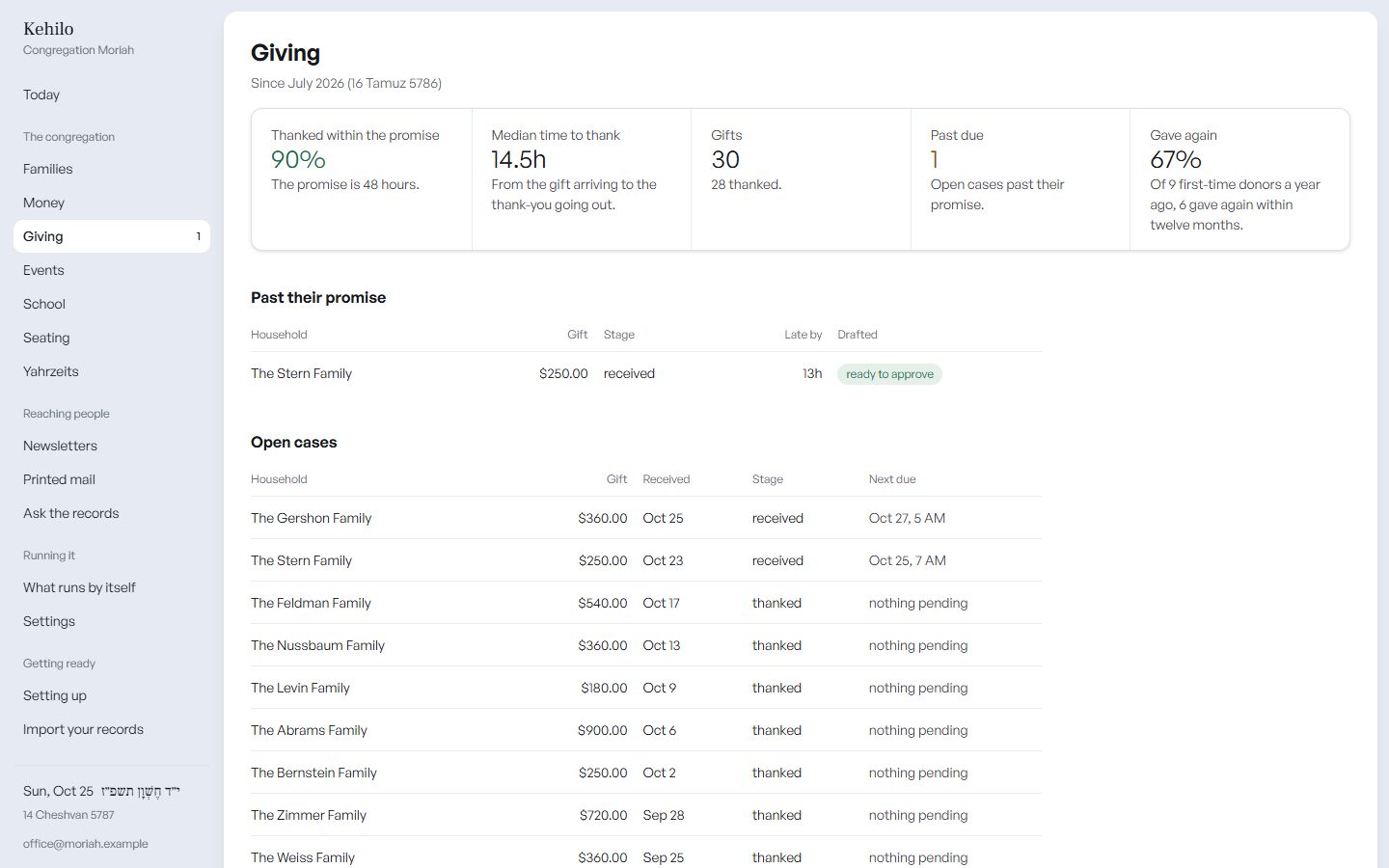
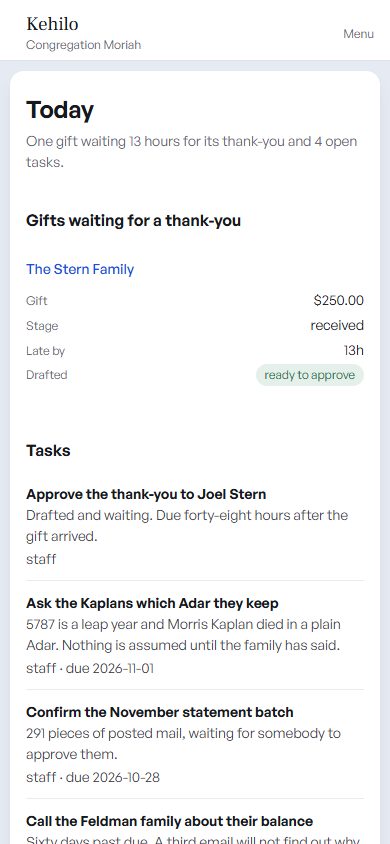
That is a photograph of the console running on a congregation’s own records. Ninety per cent is ninety per cent because two thank-yous this year went out late, and the gift at the top is waiting because it has been waiting thirty-one hours.
A family is typed in once
A new household goes into the directory, the billing, the school roster, the newsletter list and the website at the same moment, because they are the same record rather than five copies of it. Nobody re-keys and nobody forgets the fifth one.
The thank-you goes out before you ask
A gift arrives, a draft is written, and a person approves it. The median gift on the screen above was thanked in fourteen and a half hours. The office never starts from a blank page and no gift waits for somebody to remember it.
The statement run stops being a day
Every household’s statement is built from what it already owes, and the whole batch waits in one place for one person to approve. The work that used to be a Thursday is now a decision.
One record, not five exports.
The dues, the school bill, the seats, the gift and the name read from the bimah are the same family.
People
This year
Observed
Four weeks, not four months.
Your directory comes across in a day.
The old system stays exactly where it is until the day you pick, and the five checks are yours to read, not ours to assert.
An ordinary Tuesday, with the hours put back.
None of this is a new thing to learn. It is the same four jobs the office already does, with the part that used to take the morning taken out.
Somebody rings, and you have four seconds
A surname, a telephone number however it was punctuated, or any part of an email. Hebrew names are searched too, in both the Hebrew and the transliterated field, because a gabbai should not have to know which one you stored it in.
A name read on the right Shabbat
A death after sunset is the next Hebrew day. A plain Adar has two of them in a leap year and families differ, so nothing is assumed until you have asked. The thirtieth of a short month moves rather than being missed.
The discount is shown before it is charged
The sibling rate is the line a parent queries, so the office reads it out while they are still on the telephone instead of posting a statement and waiting.
Nothing sends itself on Shabbat
No automated message leaves the building between Friday afternoon and Saturday evening. Printed mail waits for somebody to approve the batch, every time.
What comes out of it.
| Annual dues | $1,800.00 |
| Religious school, two children | $3,330.00 |
| Paid, 14 October | -$3,356.00 |
| Due now | $1,774.00 |
What it will not do.
Every one of these is enforced in the software, not promised in a brochure.
| It will not | Which means |
|---|---|
| Keep your books | QuickBooks stays the ledger of record and Kehilo is the sub-ledger. Your accountant keeps the system they already trust, and we never post a journal entry they did not expect. |
| Show another congregation your rows | Every table is separated inside the database itself. Another congregation’s records are not filtered out of a query; they are invisible to it. |
| Send on Shabbat | Nothing automated goes out between Friday afternoon and Saturday evening, and posted mail waits for a person to approve the batch. |
| Charge you for a module | There are no tiers and no feature gates anywhere in the code, so there is no upgrade to be sold and nothing to withhold. The religious school is not a premium module, and nor is your website. |
The awkward questions.
What happens to our history? It comes across read-only and stays readable forever. Only opening balances and open items are written to QuickBooks, so nothing is restated and your old reports still agree with themselves.
Who owns the data? You do. An export of everything, in formats a person can open, is available on any day without asking us first.
What about our website? It is included. Your congregation’s own site runs on the same records, so a service time changed in the office is changed on the website and in the calendar feed at the same moment.
Do we have to move our accounting? No, and you should not. QuickBooks stays the ledger of record.
What if we are mid-year? Then you go live mid-year. The migration reconciles to the day you choose, not to a fiscal boundary.
How long until we are on it? Weeks. The limit is how quickly your five reconciliation checks pass, not how quickly we can import a file.
Who do we ring? Us. There is no reseller and no implementation partner between you and the people who wrote it.
What if we outgrow it? There is nothing to outgrow into. Every congregation on Kehilo runs the same software with the same modules turned on.
A 300-household congregation paying $350 a month, plus a website and a newsletter tool, gets about 546 hours a year back and saves about $1,872 in cash. No per-member pricing, no setup fee, no tier above this one, and the religious school is not an upsell.
Tell us the day you want to be on it.
And we will tell you what it takes to be ready for it.